
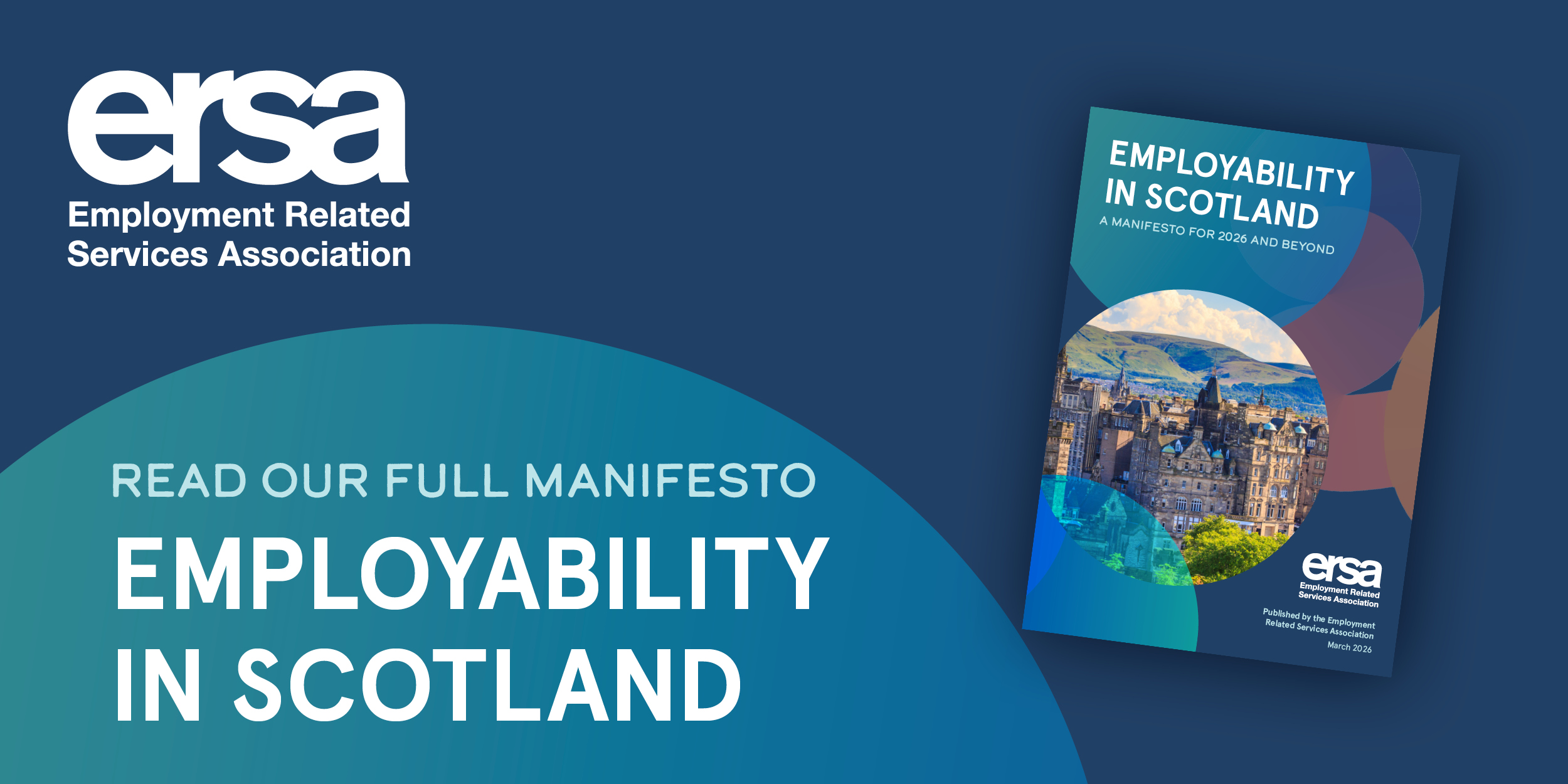
As we approach the Holyrood election in May 2026, ERSA has published our manifesto: Employability in Scotland: A manifesto for 2026 and beyond.
The manifesto has been developed by ERSA members in Scotland and outlines plans to help the Scottish government achieve its ambitions around reducing child poverty, delivering Fair Work and supporting the transition to net-zero.
ERSA Scotland members have decades of experience of delivery in Scotland, beginning with the Youth Training Scheme in the 1980s through to Fair Start Scotland, No One Left Behind and the UK Shared Prosperity Fund in the 2020s.
It is titled ‘for 2026 and beyond’ because it is intended not only to inform debate during the election campaign, but also to shape ERSA’s engagement with MSPs, local authorities and partners in the years ahead.
This year’s election comes at an increasingly important time for policymakers in Scotland. The labour market faces some stubborn issues, with 268,600 people economically inactive because of ill-health, and an estimated 16% of young people are not in education, employment or training.
If Scotland is to achieve the UK-wide ambition of an 80% employment rate, we require to support up to 200,000 additional residents to enter, sustain and progress in work.
The manifesto is published at a time of uncertainty for employability services. Funding schemes such as the UK Shared Prosperity Fund are ending, huge question marks around the Local Growth Fund remains and the annualised funding cycle, fragmented commissioning and variation in commissioning of No One Left Behind leads to disparate outcomes across Scotland.
The Scottish Government announced a yearly budget for employability of £104.6 million in 2026-27 spending plans. However, this represents a 22% reduction in overall funding since 2023-24.
A reformed employability system can help address some of the challenges facing jobseekers, employers and local areas, while supporting Scotland’s wider economic and social ambitions.
The manifesto is underpinned by five key themes:
The recommendations focus on making the system easier for individuals and employers to navigate, as well as making work better, and moving people out of poverty.
Being in good work is good for local economies; it can lift out children of poverty; and it lowers pressure on probation and health services. Scotland has clear targets around reducing child poverty, the green transition, and making Scotland a better place to work, but it risks falling short of these if it continues the same path.
Employment support providers understand the nuances of local labour markets, barriers faced by citizens, and what drives successful outcomes. A sufficiently funded model of employability that allows long-term continuity and integration across services can improve poverty rates, improve health outcomes, help halve the disability employment gap and lift pressure on other services.